
Article Preview
Introduction
When a software product reaches the point where access needs to be controlled, most teams face the same question: Should we build our own licensing system, or should we use a dedicated solution?
Building internally often appears straightforward. Licensing looks like a small piece of functionality: generate a license key, validate it in the application, maybe store it in a database.
Many teams implement a basic licensing system in a few days, but licensing rarely stays simple. As software products grow, licensing begins to influence pricing models, product packaging, infrastructure architecture, and more.
What initially looked like a small engineering task gradually becomes commercial infrastructure. This whitepaper examines the build-vs-buy decision for software licensing, exploring how licensing systems evolve over time, and when it makes sense to treat licensing as dedicated infrastructure.
1 What a Licensing System Actually Represents
Licensing is often described as a gate that controls access to software. In practice, it becomes far more than that. A licensing system connects technical enforcement with business decisions.
Business Layer
Licensing systems influence:
· Revenue Protection
· Pricing and Packaging
· Trial and Subscription Models
· Upgrade and Downgrade Paths
Engineering Layer
Licensing systems must provide:
· Secure Validation
· Protection Against Bypass Attempts
· Feature Entitlements & Usage Tracking
· Offline Usage Support
2 Why Licensing Looks Simple at First
Many teams begin by building licensing internally:
· The product is still small
· Requirements are limited
· Engineering teams want full control
Licensing may only need to answer a simple question: Is this user allowed to run the software? This leads to simple implementations:
· License keys
· Basic database checks
· Feature flags
For early products or limited distribution, this approach can work well.
However, most commercial software does not remain static.
3 How Licensing Systems Evolve Over Time
Licensing complexity tends to grow alongside the product and the business. What starts as a simple key validation system often evolves into something much more complex.
Stage 1 - Initial Implementation: Typical characteristics: simple license key format, validation inside the application, minimal infrastructure. Engineering effort is usually low.
Stage 2 - Product Packaging: As products grow, companies introduce feature tiers, multiple product editions, trial licenses, and subscription renewals. Licensing logic becomes intertwined with product logic.
Stage 3 - Customer Reality: Real customers introduce real-world requirements, such as customer-specific exceptions, contract terms, offline environments, and legacy compatibility. These edge cases add significant complexity.
Stage 4 - Product Ecosystem: Larger software vendors often develop multiple products, plugins or SDKs, integrations, and enterprise deployments. Licensing must now support multiple product configurations.
Stage 5 - Operational Complexity: Eventually, licensing systems begin affecting operations. Support teams troubleshoot licensing issues, pricing changes require engineering work, compatibility issues appear across product versions.
At this stage, licensing often behaves more like infrastructure than application logic.
4 The Hidden Costs of Internal Licensing Systems
The cost of internal systems is rarely visible at first. Most teams estimate only the initial implementation cost, but the long-term costs tend to be larger.
Engineering Cost
Licensing code often becomes:
· Difficult to refactor
· Tightly coupled with product logic
· Risky to change
The system must also successfully resist tampering, key sharing, and bypass attempts.
Business Cost
Licensing also slow business decisions:
· Pricing changes require engineering
· New products requiring code changes
· Complex licensing exceptions
Maintenance costs usually increase with time and become costly distractions.
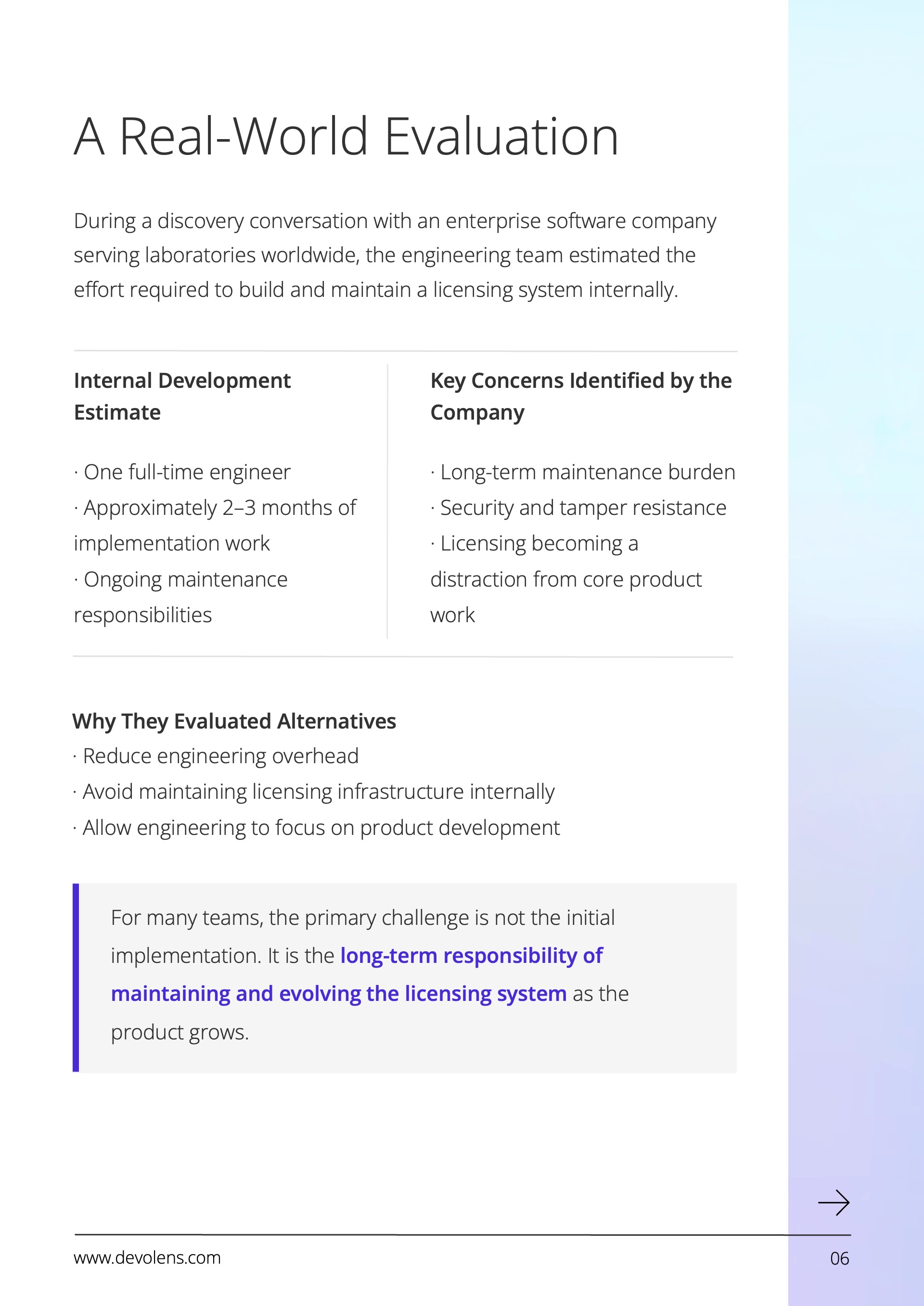
A Real-World Evaluation
During a discovery conversation with an enterprise software company serving laboratories worldwide, the engineering team estimated the effort required to build and maintain a licensing system internally.
Internal Development Estimate:
· One full-time engineer
· Approximately 2–3 months of implementation work
· Ongoing maintenance responsibilities
Key Concerns Identified by the Company:
· Long-term maintenance burden
· Security and tamper resistance
· Licensing becoming a distraction from core product work
Why They Evaluated Alternatives
· Reduce engineering overhead
· Avoid maintaining licensing infrastructure internally
· Allow engineering to focus on product development
For many teams, the primary challenge is not the initial implementation. It is the long-term responsibility of maintaining and evolving the licensing system as the product grows.
5 When Internal Licensing Remains Practical
Despite the challenges, building licensing internally can be reasonable in some cases.
Examples include:
· Internal tools with limited distribution
· Short-lived products
· Extremely simple licensing requirements
· Environments where licensing rarely changes
In these situations, the long-term maintenance burden may remain manageable.
However, most commercial software products evolve over time.
6 When Licensing Becomes Infrastructure
For many companies, licensing eventually becomes part of their infrastructure. This tends to happen when companies plan to:
· Sell their own software
· Support multiple pricing tiers
· Evolve pricing over time
· Support enterprise deployments
Licensing then begins to resemble other infrastructure systems such as:
· Authentication
· Payment processing
· Analytics
Systems like these are rarely built internally today.
7 Build vs Buy Decision Framework
[Download the whitepaper to gain full access and continue reading]