Introducing Devolens MCP and Skills: Support for Licensing Insights and Operations
AI agents are becoming a normal part of software development workflows.
Many teams already use AI assistants to write code, investigate technical issues, review documentation, and accelerate implementation work. As these tools become more capable, the question is no longer whether AI will be part of development workflows.
The question is how to provide AI with the context and access it needs to be genuinely useful.
For software licensing, that challenge exists at two levels.
- First, AI needs to understand how a licensing platform works.
- Second, AI needs a secure way to interact with real licensing data and licensing operations.
To address both challenges, Devolens now includes Skills and an MCP Server.
Skills help AI agents understand Devolens-specific implementation patterns, workflows, and documentation.
The MCP Server allows authorized AI agents to work with licensing data and approved licensing operations within a Devolens account.
Together, they create practical workflows for both implementation and ongoing licensing operations while maintaining control through permissions, auditing, and restricted access.
Helping AI Understand Devolens
AI models are increasingly capable of helping developers implement licensing functionality.
Most models already understand concepts such as:
- License validation
- Feature licensing
- Subscription licensing
- Offline licensing
- Usage-based licensing
Understanding licensing concepts is not the same thing as understanding a specific licensing platform.
A generic AI model may understand what offline licensing is, but it does not automatically know:
- How offline licensing works in Devolens
- Which APIs are involved
- Which implementation patterns are recommended
- Which configuration options are available
- How different licensing models are configured
This is where Skills become valuable.
Skills provide AI agents with Devolens-specific documentation and implementation guidance so they can work from platform-specific knowledge rather than assumptions.
For example, teams can use AI agents to help implement:
- Trial licensing
- Feature-based licensing
- Subscription licensing
- Offline licensing
- Payment and billing integrations
- Customer provisioning workflows
Instead of searching through documentation, assembling examples, and translating licensing concepts into implementation details, developers can work directly with AI agents that understand how Devolens approaches these workflows.
This does not remove engineering decisions from the process.
It helps AI provide more relevant implementation guidance based on how the platform actually works.
If you're interested in how Devolens Skills help AI agents implement licensing workflows, read our Devolens Skills Capability Guide.
Using AI Agents for Licensing Operations
Implementation is only one part of the licensing lifecycle.
Teams also spend significant time investigating issues, reviewing licensing activity, supporting customers, analyzing usage patterns, and identifying opportunities to improve monetization.
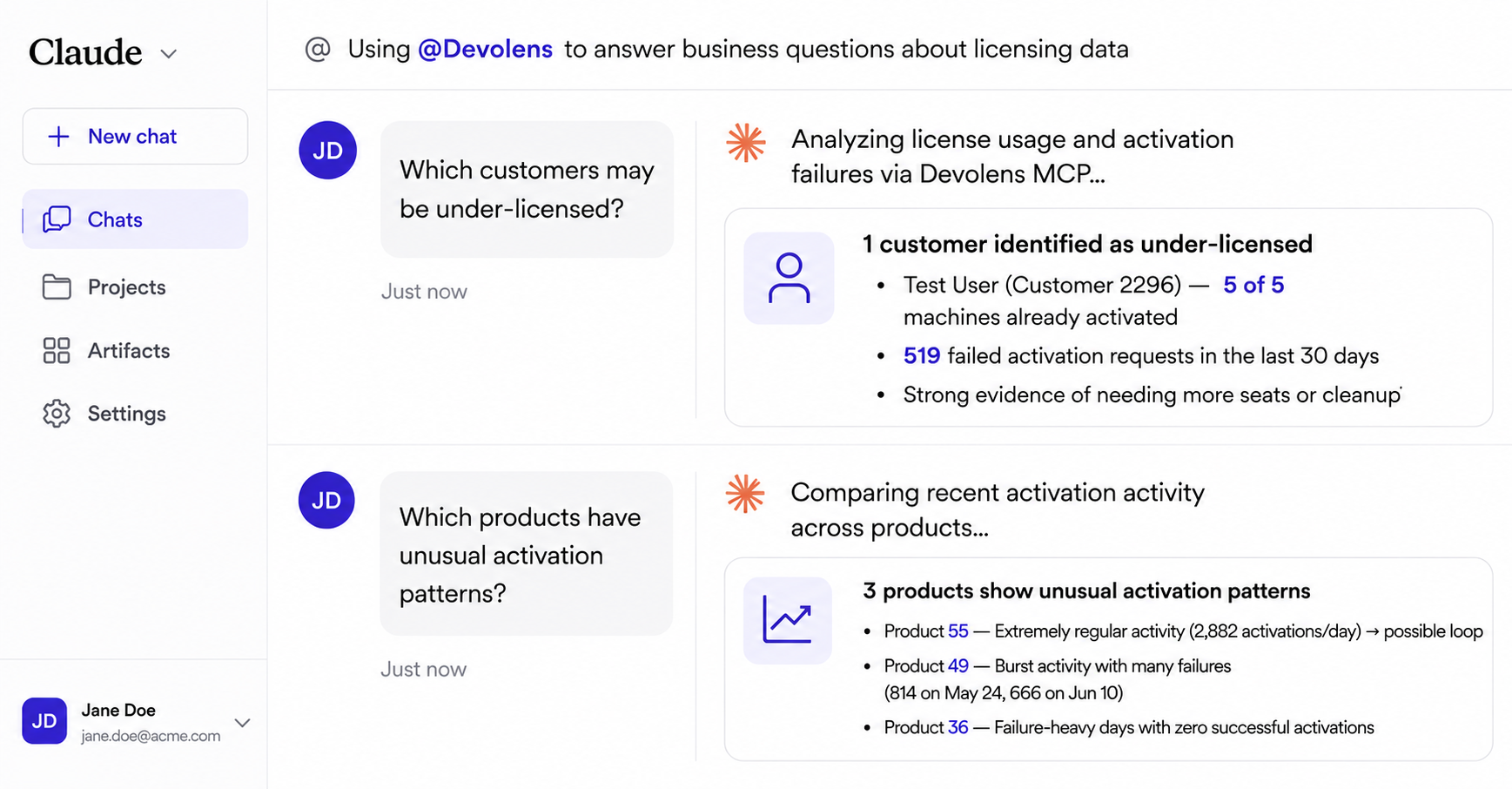
The Devolens MCP Server allows authorized AI agents to assist with these operational workflows using real account data.
A support investigation is a simple example.
If a customer reports that a license cannot be activated, an AI agent can help gather relevant information such as:
- Customer information
- Associated licenses
- Recent activity
- Activation history
- Potential causes of the issues
Instead of manually moving between multiple screens, support teams can retrieve and organize information more efficiently.
The same applies to operational reporting and analysis.
Teams can ask straightforward questions such as:
- Which products generated the most activity last month?
- Which customers recently activated new licenses?
- Which license keys are seeing the highest usage?
More interestingly, teams can also explore broader operational questions.
Examples include:
- Which features appear suitable for usage-based pricing?
- Are certain licensing models driving significantly more usage than others?
- Are there signs that customers may benefit from a different licensing plan?
- Which trial users show strong conversion potential?
- Are there unusual activation patterns that deserve investigation?
- Which products appear under-monetized relative to usage?
In these scenarios, AI is not simply retrieving data.
It helps teams identify patterns, investigate trends, and explore opportunities using the licensing information already available within their Devolens account.
Skills and MCP Work Together
Although Skills and MCP solve different problems, they often complement each other.
Skills help AI understand Devolens.
MCP helps AI understand your licensing environment.
Many practical workflows benefit from both.
For example:
- MCP identifies that a particular feature is generating unusually high usage.
- An AI agent analyzes the data and suggests introducing a usage-based licensing model.
- Skills help implement the required licensing changes within Devolens.
Similarly:
- MCP identifies activation patterns that suggest a deployment challenge.
- AI helps investigate the issue.
- Skills assist with implementing a revised licensing configuration.
The result is a workflow where AI can help analyze information, identify opportunities, and support implementation using platform-specific knowledge.
Maintaining Control Over Access
As AI agents gain access to more business systems, controlling that access becomes increasingly important.
Organizations should be able to decide what AI agents can access, which actions they can perform, and how that access is governed.
For this reason, MCP access is disabled by default.
Organizations explicitly decide whether access should be enabled and what permissions should be granted.
Controls include:
- OAuth-based authorization
- Permission-based access controls
- Function-level restrictions
- Access revocation
- Audit logging
- Data minimization controls
This makes it possible to support AI-assisted workflows while maintaining operational control over licensing data and licensing operations.
For example, an organization may allow an AI agent to review analytics while restricting its ability to perform operational actions.
Another organization may allow customer support workflows while limiting access to specific licensing functions.
When using the Devolens MCP, it is also possible to fully exclude all personal data from being shared, which supports a data-minimization approach under GDPR and similar regulations.
The goal is straightforward.
AI agents should only have access to the information and operations required for a specific task.
To learn more about connecting AI agents to your Devolens account, supported workflows, and security controls, see our Devolens MCP Capability Guide.
Looking Ahead
AI agents are increasingly becoming another interface layer for software systems.
For software licensing, this creates opportunities across the entire lifecycle.
Teams can use AI to:
- Understand platform-specific implementation patterns
- Accelerate licensing integrations
- Investigate support issues
- Analyze licensing activity
- Explore monetization opportunities
- Review operational trends
- Assist with ongoing licensing improvements
Dashboards, APIs, and existing workflows remain important.
What changes is that teams gain another way to access information, analyze activity, and interact with licensing systems when it makes sense to do so.
Skills and MCP are designed to support that shift by helping AI understand both how Devolens works and what is happening within a licensing environment.
Get Started with Devolens
Deploy licensing with a leading software licensing provider without long implementation cycles or added operational overhead.