Software License Activation: How It Works and What to Consider
Software license activation is the process of associating a software license with a customer, user, or device before the software can be used. It is commonly used by commercial software companies to control access, enforce licensing terms, and manage how licenses are distributed across installations.
The exact activation process depends on the licensing model and how the software is deployed. A desktop application may activate against a specific machine, while enterprise software may use a license server or operate in an offline environment.
What Is Software License Activation?
A typical activation process starts when a customer receives a license key or license file. The application uses this information to request an activation from the licensing system.
The licensing system then checks the license and, if the activation is valid, returns the information the application needs to verify and enforce the license.
For example, an activation request may contain:
- A license key
- A product identifier
- A machine or installation identifier
- Authentication information
The response can contain information such as the license status, expiration date, enabled features, and activation details.
The application can then use this information to determine whether the customer should be allowed to use the software.
For a broader explanation of the components involved, see our guide on how software licensing works.
How Online License Activation Works
Online activation is the most straightforward approach when the application can communicate with a licensing service.
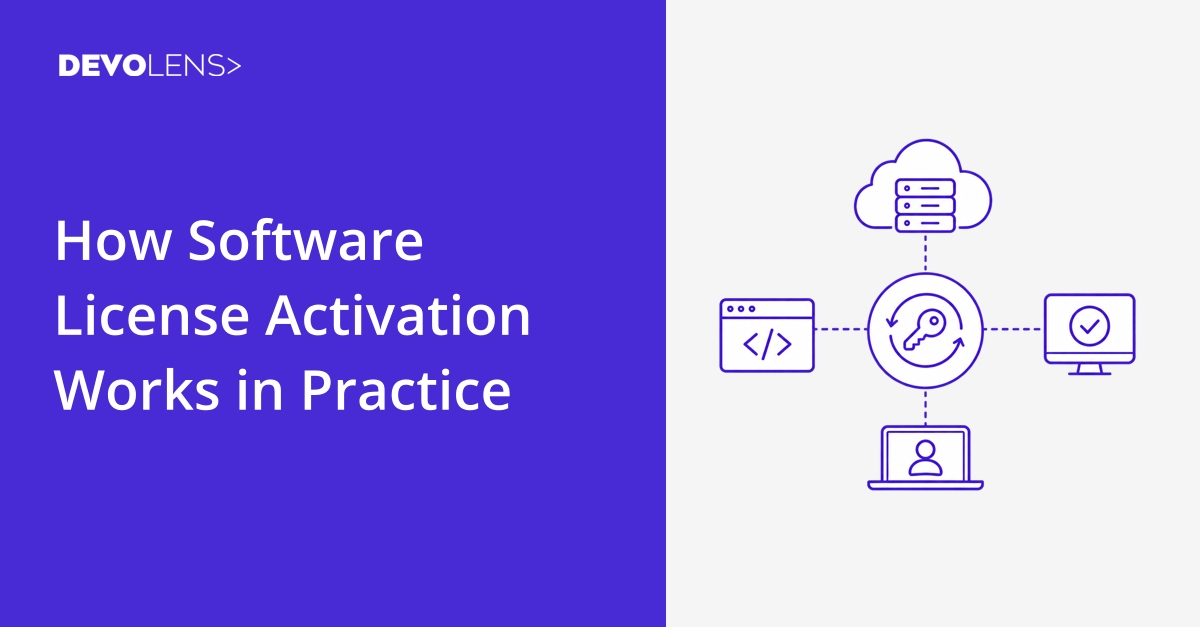
A simplified activation flow looks like this:
- The customer enters or receives a license key.
- The application sends the key and relevant application information to the licensing service.
- The licensing service verifies the license.
- The service records the activation if required.
- The application receives the license information.
- The application verifies the response and enables the appropriate functionality.
Online activation makes it possible to enforce activation limits and update licensing information centrally. For example, a software company can revoke a license, change its entitlements, or allow a customer to activate the software on another machine.
The application should still verify the returned license data before relying on it. Devolens supports signed license responses so that applications can verify that the licensing information has not been modified.

Machine Binding and Activation Limits
Many desktop applications use machine based activation to limit how many computers can use a license.
During activation, the application generates a machine code and sends it with the license key. The licensing service can then associate the activation with that machine.
This is useful when a license is intended for one workstation or a defined number of installations. It can also provide a way to manage activations when customers replace computers or reinstall the software.
However, machine binding is not appropriate for every application. Server software, virtualized environments, containers, and enterprise deployments may require a different approach to identifying an installation.
The important question is therefore not simply whether a licensing system supports machine activation, but whether the activation model matches how your customers actually deploy the software.
Offline Software License Activation
Some applications cannot reliably communicate with an external licensing service.
This is common for software deployed in restricted networks, industrial environments, secure facilities, or other environments where Internet access is unavailable or prohibited.
In these cases, activation can be performed using a license file or another signed piece of licensing data. The customer can obtain the required license information separately and transfer it to the computer running the application.
The application can then validate the license locally without contacting the licensing service during normal operation.
Devolens supports offline licensing for applications that need to operate without continuous Internet connectivity.
For larger enterprise environments, a license server can provide a centralized licensing system within the customer's network. This can be useful when multiple applications or users need to share access to licenses without giving every machine direct access to an external service.
License Reactivation and Reinstallation
Activation also needs to account for what happens after the initial installation.
Customers may replace their computer, reinstall the operating system, move the application to another machine, or need to recover from a hardware failure.
If every installation is treated as permanently consuming an activation, customers can quickly run into unnecessary activation problems.
A licensing system should therefore provide a defined way to deactivate, release, or otherwise manage existing activations. The appropriate approach depends on the licensing model and the degree of control the software vendor wants to provide.
For example, a node locked license might allow a customer to move an activation between machines, while an enterprise license might allow several predefined activations or use a floating license model instead.
License Activation and Security
The activation process is part of the security boundary of a commercial application. License keys and activation credentials should therefore be handled carefully.
Applications should avoid embedding sensitive credentials that provide unnecessary access to the licensing system. License responses should also be validated before the application trusts their contents.
Signed license information can provide an additional layer of protection by allowing the application to verify that important licensing data was issued by the licensing system and has not been modified.
The exact security requirements depend on the application and threat model. A licensing system should be designed so that compromising a client application does not provide unnecessary access to administrative functionality or other customers' licensing data.
Designing a License Activation Workflow
There is no single activation workflow that is appropriate for every software product.
A desktop application sold directly to individual customers may use a license key and machine activation. A B2B application may associate licenses with organizations and users. Software deployed in an air gapped environment may require file based activation, while enterprise infrastructure may use a local license server.
Before implementing activation, it is useful to define:
- What identifies the customer?
- What identifies an installation?
- How many activations should a license allow?
- What happens when a customer changes machines?
- Does the application require Internet access?
- What happens when the licensing service is temporarily unavailable?
- Which features or usage limits are controlled by the license?
These decisions determine the activation architecture and help prevent problems later when the licensing requirements become more complex.
Choosing an Activation Approach
For many applications, online activation provides the simplest starting point. It allows the licensing service to manage activations centrally and makes it easier to update licensing information over time.
Applications with restricted connectivity may instead require offline activation or a license server. Products with complex entitlements may need activation to return more information than simply whether a license key is valid.
The activation process should ultimately reflect the way the software is sold and deployed rather than forcing every customer into the same model.
A licensing platform such as Devolens can provide the underlying activation and license management infrastructure while allowing the application to implement the specific licensing rules it needs.
Conclusion
Software license activation connects a customer's license to the application that will use it. A well designed activation workflow needs to consider more than simply checking whether a license key is valid.
Machine identity, activation limits, entitlements, reactivation, security, connectivity, and offline operation can all affect how activation should be implemented.
Choosing the appropriate activation model early can make it easier to support new licensing models and deployment environments as the software product grows.
Get Started with Devolens
Deploy licensing with a leading software licensing provider without long implementation cycles or added operational overhead.