SDK Licensing: The Unique Challenges of Commercial SDKs
Licensing an SDK introduces challenges that most commercial software products never encounter.
Unlike desktop applications or SaaS products, an SDK is distributed to developers who integrate it into their own software. Your customer is not the person ultimately using the functionality. Instead, your SDK becomes one component within another commercial product.
That architectural difference affects how licensing should be designed, how commercial models are enforced, and how you balance security with the developer experience.
This article explores the unique considerations of commercial SDK licensing and what software companies should think about before choosing a licensing strategy.
Why SDK Licensing Is Different
Most commercial software is licensed directly to the person using the application.
SDKs follow a different model.
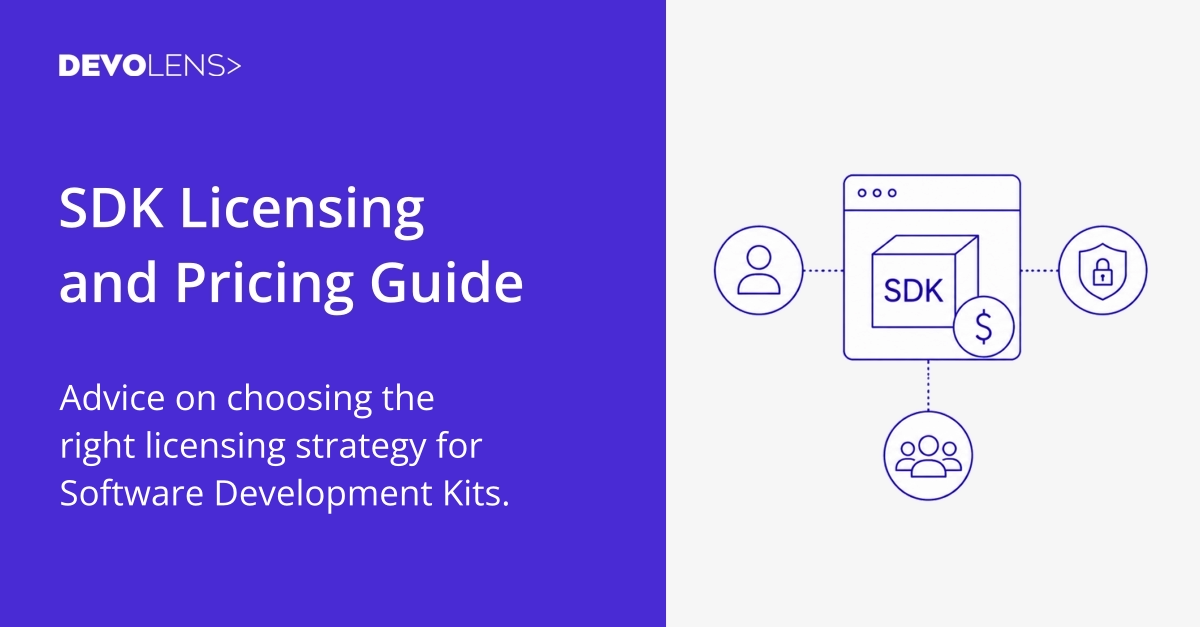
There are typically three parties involved:
- The company developing and selling the SDK.
- The software company integrating the SDK.
- The end users of the finished application.
The SDK vendor licenses the software company, not every individual end user.
Because the SDK is embedded inside another application, licensing must distinguish between the licensed customer and the users of the final product. This introduces architectural considerations that desktop applications often do not face.
Protecting a Component Rather Than a Product
One of the biggest differences with SDK licensing is that you are protecting a reusable software component rather than a finished application.
The licensing system must allow authorized customers to integrate the SDK while preventing unauthorized redistribution or use.
In practice, this often means the licensing infrastructure needs to:
- Identify the licensed customer.
- Authenticate the integrating application.
- Protect licensing information from end users.
- Prevent unauthorized redistribution of the SDK.
- Support updates as the SDK evolves over time.
Unlike traditional applications, SDK licensing often needs to operate without disrupting the developer's own product or development workflow.
Balancing Security with Developer Experience
Commercial SDKs are ultimately adopted by developers.
Strong protection is important, but licensing should not become an obstacle to integration.
An SDK that is difficult to activate, unreliable during development, or overly restrictive can create unnecessary friction for customers who are evaluating or integrating the product.
Successful SDK licensing therefore balances two goals:
- Protecting commercial intellectual property.
- Providing a predictable and straightforward developer experience.
Finding the right balance is often just as important as the underlying licensing technology.
Choosing the Right Commercial Model
SDK licensing also provides considerable flexibility when it comes to pricing.
The most appropriate commercial model depends on how customers receive value from the SDK.
Examples include:
- Subscription licensing.
- Per-application licensing.
- Per-installation licensing.
- Per-organization licensing.
- Usage-based pricing.
- Feature-based licensing.
For some SDKs, charging according to installations or actual usage aligns pricing more closely with the value customers receive than a fixed subscription alone.
Choosing the right pricing model is ultimately a commercial decision that should reflect both customer expectations and how the SDK is deployed.
Deployment Considerations
SDKs are used in a wide range of environments.
Some are integrated into cloud-native applications, while others become part of desktop software, engineering tools, enterprise systems, or products operating without continuous internet connectivity.
These deployment scenarios influence how licensing is implemented.
For example, products operating in offline environments require different validation strategies than applications that can continuously communicate with cloud services.
Our guide to offline software licensing explains these approaches in greater detail.
Licensing Infrastructure for Commercial SDKs
As SDK products evolve, licensing requirements often become more sophisticated.
Organizations may introduce multiple editions, enterprise customers, usage-based pricing, or customer-specific licensing rules that increase operational complexity.
Modern licensing platforms help separate licensing infrastructure from the SDK itself, allowing engineering teams to evolve commercial models without embedding every licensing workflow directly into product code.
If you're looking for a broader introduction to licensing infrastructure, our guide explaining what a software licensing system is provides additional context.
How Devolens Supports SDK Licensing
SDKs introduce requirements that differ from many other commercial software products, and Devolens includes capabilities specifically designed for these scenarios.
Our SDK use case page explains how Devolens supports commercial SDK licensing, common deployment patterns, and approaches for protecting SDKs while maintaining a smooth developer experience.
Final Thoughts
SDK licensing is fundamentally different from licensing traditional software applications.
Because the licensed customer is integrating your technology into their own product, licensing must protect a reusable component while remaining straightforward for developers to adopt and maintain.
By choosing licensing infrastructure that supports your deployment model, pricing strategy, and long-term product roadmap, engineering teams can protect their commercial SDK without making licensing an obstacle to developer adoption.
Get Started with Devolens
Deploy licensing with a leading software licensing provider without long implementation cycles or added operational overhead.