How to Implement a Software Licensing System
Implementing a software licensing system involves much more than validating a license key.
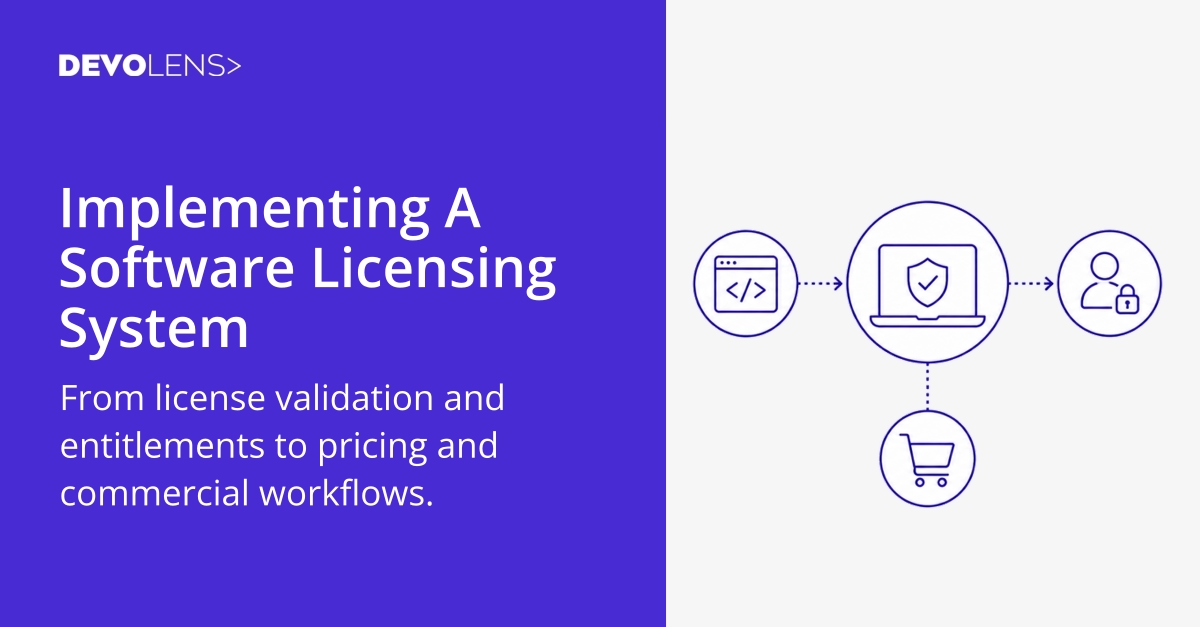
At a high level, most implementations follow the same process:
- Choose the licensing model that fits your product.
- Integrate license validation into your application.
- Enforce customer entitlements such as features, usage limits, or subscriptions.
- Connect licensing with your commercial workflows, such as billing and renewals.
- Deploy, monitor, and evolve the licensing infrastructure as your product grows.
The exact implementation depends on your product architecture, deployment model, and commercial strategy, but these five steps form the foundation of most commercial licensing systems.
This article explains what each step involves and the architectural decisions engineering teams typically make before implementing licensing.
Step 1: Choose Your Licensing Model
Before writing any licensing code, decide how customers will purchase and use your software.
Your licensing model determines which commercial rules the licensing system will ultimately enforce.
Common approaches include:
- Subscription licensing.
- Perpetual licenses.
- Floating licenses.
- Usage-based pricing.
- Feature-based licensing.
Many commercial products combine several of these approaches.
If you're comparing different commercial models, our introduction to software licensing models provides a broader overview.
Step 2: Integrate License Validation
Once the commercial model has been defined, the application needs a way to determine whether a customer is entitled to use the software.
In most implementations, the application validates a customer's license whenever it starts or whenever protected functionality is accessed.
Depending on the product, this validation may determine:
- Whether the license is valid.
- Which product edition the customer owns.
- Which features should be enabled.
- Whether usage limits have been reached.
- Whether the subscription remains active.
If you're looking for a broader explanation of how licensing systems perform these tasks, our guide to software licensing systems explains the underlying concepts in more detail.
Step 3: Implement Commercial Rules
License validation is only one part of a commercial licensing system.
The application also needs to enforce the commercial rules that define what each customer has purchased.
This commonly includes:
- Feature entitlements.
- Product editions.
- Device activations.
- Subscription expiry.
- Usage limits.
- Customer-specific licensing rules.
Keeping these rules separate from the application's core functionality makes them easier to evolve as commercial requirements change.
Step 4: Connect Licensing with Business Operations
Modern licensing systems rarely operate in isolation.
Instead, they become part of the broader commercial workflow.
For example, licensing often needs to integrate with:
- Payment systems.
- Customer provisioning.
- Subscription renewals.
- CRM platforms.
- Support workflows.
This allows customer access to remain synchronized with commercial events throughout the product lifecycle.
Many organizations also automate these workflows to reduce manual administration.
Our guide to automating software licensing explores these operational workflows in greater detail.
Step 5: Plan for Future Requirements
Licensing requirements often expand as software products mature.
Products may introduce:
- Additional pricing models.
- Enterprise customers.
- Offline deployments.
- Multiple product editions.
- New deployment environments.
Planning for these possibilities early makes it easier to extend the licensing system without repeatedly redesigning its architecture.
Cloud-based licensing platforms are often chosen for this reason because they separate licensing infrastructure from application code while making future commercial changes easier to manage.
Build Your Own or Use a Licensing Platform?
Once the implementation requirements are understood, organizations generally choose one of two approaches.
The first option is to build and maintain the licensing system internally.
This provides complete control but also requires engineering teams to design, maintain, secure, and continuously evolve the licensing infrastructure themselves.
The second option is to use a dedicated licensing platform.
Rather than building every operational capability from scratch, engineering teams integrate with an existing licensing platform while focusing their own development efforts on the product.
If you're evaluating these options, our guide to replacing an internal licensing system discusses when organizations typically begin considering dedicated licensing infrastructure.
For smaller projects with relatively simple requirements, some teams also begin with an internal license key generator before moving to more comprehensive licensing infrastructure as commercial requirements grow.
Implementing Licensing with Devolens
Devolens provides the infrastructure required to implement commercial software licensing without building the entire platform internally.
Engineering teams can implement license validation through SDKs and APIs while managing subscriptions, feature entitlements, usage tracking, offline licensing, and operational workflows through a centralized licensing platform.
Organizations that want implementation assistance can also use our migration and implementation support service, whether they are introducing licensing for the first time, replacing an internal solution, or migrating from another licensing provider.
For teams that want to validate how Devolens fits into their architecture before beginning a full implementation, we also offer a dedicated Proof of Concept service.
Final Thoughts
Implementing a software licensing system is ultimately about building the commercial infrastructure that supports your product.
The technical implementation begins with license validation, but a complete licensing solution also supports pricing models, feature entitlements, customer management, operational workflows, and future product growth.
Whether you build licensing internally or adopt a dedicated licensing platform, treating licensing as infrastructure rather than simply an access check makes it significantly easier to evolve your commercial software over time.
Get Started with Devolens
Deploy licensing with a leading software licensing provider without long implementation cycles or added operational overhead.